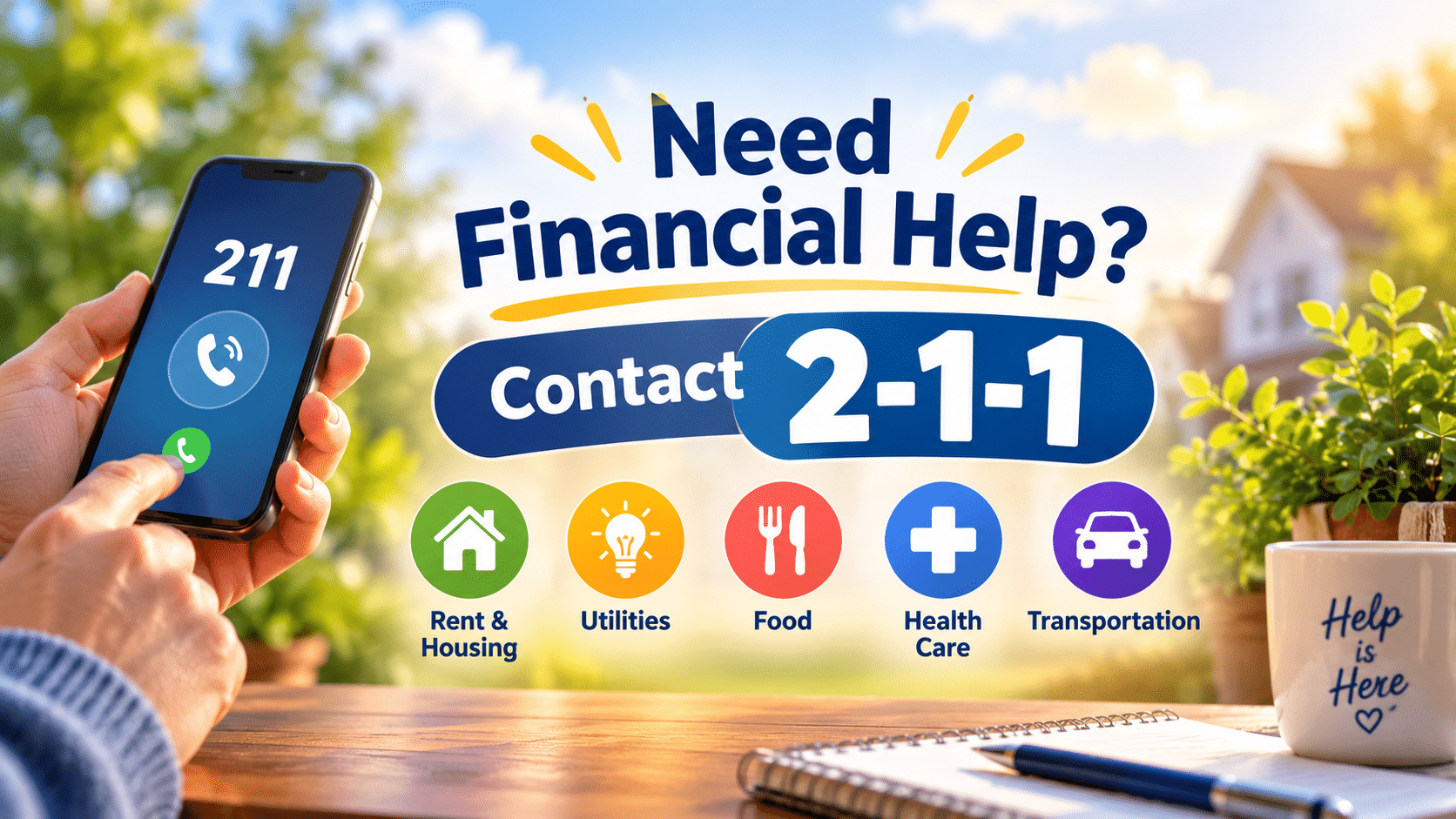
Most people know to call 911 when there is a life-threatening emergency. Far fewer know about another three-digit number that can help when the emergency is financial or involves basic everyday needs.
The rent is overdue. The power company has sent a disconnect notice. The refrigerator is nearly empty. You need transportation to work. A medical expense has thrown the household budget into trouble. Or perhaps you are simply trying to help a parent, neighbor, employee, friend, or family member who does not know where to turn.
That number is 211.
But there is something important to understand: 211 is more than a phone number.
Across the country, local 211 organizations connect people with community resources through phone service and, depending on location, searchable websites, text, online chat, email, or other digital tools.
So the better advice today is not simply “Call 211.”
It is:
Contact 211 before a financial emergency gets worse.
What Is 211?
211 is a nationwide information and referral network that connects people with local health and human-service resources.
The Federal Communications Commission designated 211 for community information and referral services, creating an easy-to-remember number for people trying to find help with non-emergency needs.
Today, local 211 specialists help people locate resources involving housing, food, utilities, transportation, health care, child care, employment, disaster recovery, senior services, veterans services and many other needs.
According to United Way 211, the U.S. network made more than 19 million connections to help, resources and services in 2025.
That tells us something important: needing help finding assistance is far from unusual.
211 Usually Connects You With Help — It Doesn’t Usually Provide the Money
This distinction is essential.
211 generally isn’t a bank, government benefits program or emergency cash fund.
Instead, 211 specialists and databases help connect people with organizations that may be able to provide assistance, including:
- Government programs
- Community nonprofits
- Food banks and food pantries
- Housing organizations
- Utility-assistance programs
- Health and behavioral-health resources
- Legal-aid organizations
- Veterans programs
- Senior and disability services
- Community and faith-based organizations
Think of 211 as a community-resource navigator.
If you don’t know who can help—or even what kind of assistance you should be looking for—211 can be an excellent place to start.
What Kind of Help Can 211 Help You Find?
Available programs differ from one community to another, but 211 may be able to connect you with resources involving:
- Rent assistance
- Mortgage and housing assistance
- Utility-bill assistance
- Food pantries and meal programs
- SNAP and other food-benefit information
- Emergency shelter
- Affordable-housing resources
- Health clinics
- Mental-health and substance-use resources
- Prescription and health-care assistance
- Transportation
- Child care
- Senior services
- Disability services
- Veterans and military-family services
- Employment and job-training resources
- Legal aid
- Disaster assistance
- Tax-preparation resources
- Financial-wellness programs
- Clothing and other basic necessities
You don’t necessarily need to know the name of the program you need.
That’s part of the point.
You can explain the problem and let 211 help identify possible resources.
Why 211 Can Be Particularly Useful During a Financial Emergency
Financial emergencies rarely arrive one at a time.
Someone may fall behind on rent because work hours were cut. Reduced income then makes the electric bill difficult to pay. Grocery money disappears. A car repair makes transportation to work uncertain.
One financial problem can quickly become four.
211 can be useful because its resource network spans multiple categories of assistance.
Instead of spending hours searching the internet and calling organizations that may not even serve your area, you can begin with your ZIP code and circumstances and ask:
“What resources should I try first?”
That does not guarantee assistance.
It does give you a place to begin.
Don’t Wait Until the Last Minute
One of the most useful financial lessons in this entire article is simple:
Ask for help early.
If your utility bill is becoming unmanageable, don’t necessarily wait for the final disconnect notice.
If you know next month’s rent is going to be a problem, don’t wait until an eviction proceeding begins.
If the food budget is disappearing, don’t wait until the refrigerator is empty.
Assistance programs can have eligibility requirements, application procedures, limited funding and waiting periods. Some programs may temporarily stop accepting applications when available funds have been committed.
Starting earlier can give you more time to explore alternatives.
211 Is More Than a Phone Call
The national 211 network has expanded well beyond telephone referrals.
Depending on your local 211, you may be able to:
- Dial 211
- Search a local 211 resource database online
- Communicate by text
- Use web chat
- Send an email
- Use other local digital services
The important phrase is depending on your local 211.
Contact options are not identical throughout the country.
The national 211 website can help you locate the organization serving your community and determine which contact methods are available there.
A Good Example: 211info
One particularly useful example of the modern 211 model is 211info, which operates Oregon’s 211 service.
Its website allows users to search resources by service type, ZIP code or city and includes guided searches for areas such as:
- Housing and shelter
- Utility assistance
- Food
- Health care
- Transportation
- Employment
- Mental and behavioral health
- Legal and public-safety resources
- Financial wellness
- Disaster services
211info also maintains a mobile app and offers phone, text and email contact.
There is an important current limitation, however: 211info’s regular phone hours are Monday through Friday, 8 a.m. to 6 p.m. Its regular hours were reduced in 2025 because of funding constraints, although hours can be expanded during certain emergencies.
And another recent change is important: 211info now serves Oregon’s 36 counties, not Southwest Washington. Since January 1, 2026, Washington 211 has directly handled Southwest Washington as part of its statewide system.
That is a good illustration of why you should always check your own local 211 for current services, hours and contact methods.
If You’re in North Carolina
For North Carolina readers, NC 211 is the statewide service provided by United Way of North Carolina.
It serves all 100 North Carolina counties.
NC 211 is:
- Free
- Confidential
- Available 24 hours a day, 7 days a week, 365 days a year
- Available with language assistance
- Staffed by trained Community Resource Specialists
- Searchable online through its statewide resource database
You can reach NC 211 by dialing:
211
or:
888-892-1162
You can also search for resources online through NC211.org.
One important distinction: NC 211 currently says that its regular 211 service does not offer text or chat. North Carolina users should call or use the online resource search.
What to Have Ready Before You Contact 211
You do not need to assemble a perfect financial file before asking for help.
If you’re overwhelmed, just start.
But having some basic information available can make the process easier.
If possible, know or gather:
- Your ZIP code or county
- Household size
- Household income and income sources
- Rent or mortgage amount
- Amount past due
- Utility account information
- Shutoff or eviction notices
- Relevant deadlines
- Identification
- Proof of income
- Lease or mortgage information
- Benefit information, if applicable
- Relevant medical information if you’re seeking health-related resources
You may not need all of these items to contact 211. A referred agency, however, may request documentation before determining whether you qualify for assistance.
Be Specific About the Problem and the Deadline
You don’t need a complicated explanation.
Instead of saying:
“I need help paying bills.”
Try:
“I have an electric disconnect notice for Friday, I owe $312, and I need to know whether there are emergency utility-assistance programs in my county.”
Or:
“I’m behind on rent and need to know whether there are rental-assistance or eviction-prevention programs near me.”
Or:
“I’m helping my mother, who lives on a fixed income. She needs help finding food assistance and transportation to medical appointments.”
Specific information can help the specialist understand what resources to look for.
The Advantages of Using 211
One Starting Point
Perhaps the greatest benefit of 211 is simply knowing where to begin.
Someone facing a financial emergency can easily spend hours searching online, calling government offices and contacting organizations that do not serve their ZIP code.
211 can narrow that search.
Local Information
Assistance is often highly local.
A program operating in one county may not serve the county next door. Utility programs may depend on the provider. Housing assistance may depend on where you live.
211 is designed around connecting people with resources serving their communities.
Help With More Than One Problem
If you contact 211 about rent, you may also discover resources involving food, utilities, transportation or benefits.
That matters because financial problems frequently overlap.
Trained Human Assistance
Calling your local 211 can connect you with a trained specialist rather than leaving you to sort through search results by yourself.
For someone who is overwhelmed, elderly, unfamiliar with government programs or simply unsure where to begin, that human assistance can be especially valuable.
Free and Confidential
211 services are generally free, and national 211 describes calls as confidential and capable of being anonymous.
You Can Help Someone Else
You do not have to be the person experiencing the problem.
A family member, caregiver, friend, neighbor or other person can use 211 to research possible resources for someone they are trying to help.
The Limitations: What 211 Cannot Promise
211 can be extremely useful, but it is important to have realistic expectations.
A Referral Is Not an Approval
Being referred to a program does not mean you qualify for it.
The organization providing assistance will determine eligibility.
Funding Can Run Out
Rental, utility and other financial-assistance programs may have limited funding.
A program may exist but temporarily have no funds available.
Programs Have Their Own Rules
Income limits, residency requirements, household circumstances, documentation and deadlines can all affect eligibility.
Information Can Change
Community programs open, close, change hours and exhaust funding.
Even a good resource database can contain information that changes after it was verified.
Confirm important details directly with the organization providing assistance.
You Still Have to Follow Through
211 can help identify the next door.
You generally still have to walk through it.
That may mean making another phone call, completing an application, submitting documents, attending an appointment or following up repeatedly.
Service Levels Vary by Location
The national network is extensive, but local 211 organizations are not identical.
Hours, online tools, languages and contact options can differ.
The changes at 211info are a good example: funding and organizational changes can affect how a local 211 operates.
A Better Strategy: Use 211 and Contact the Creditor
If you’re behind on a bill, don’t necessarily choose between contacting 211 and contacting the company you owe.
Do both.
For example, if your electric bill is overdue:
- Contact 211 to ask about local utility-assistance programs.
- Contact the utility company directly.
- Ask about payment arrangements, hardship programs, extensions or other assistance.
- Write down names, dates and what you were told.
The same principle can apply to landlords, mortgage servicers, medical providers and other creditors.
The national 211 service specifically encourages people having difficulty with utilities or housing costs to communicate directly with providers, landlords or lenders while also exploring assistance.
If the First Referral Doesn’t Work, Ask Again
This is important enough to remember:
One unsuccessful referral does not necessarily mean there is no help available.
If an organization says:
- Funding is exhausted
- You’re outside its service area
- You don’t meet its eligibility requirements
- Applications are temporarily closed
go back to 211 and explain what happened.
Ask:
“That program couldn’t help me. Are there any other resources I can try?”
United Way 211 itself encourages people to contact 211 again when resources are limited or they do not qualify for a particular service.
Your Financial-Emergency Action Plan
If you need help today, start here.
1. Contact Your Local 211
Dial 211 or use the national 211 website to find the service covering your location.
2. Explain the Immediate Problem
Be specific about amounts, deadlines, notices and what will happen if the bill isn’t paid.
3. Ask About Related Needs
If you’re having trouble with rent, ask about utilities and food too.
Reducing one expense may free money for another.
4. Ask for Backup Referrals
Whenever possible, get more than one resource.
5. Keep a Simple Contact Log
Record:
- Organization
- Phone number
- Website
- Person contacted
- Date
- What you were told
- Documents requested
- Next step
6. Gather Your Documents
Keep bills, notices, identification, proof of income, lease or mortgage information and benefit documents together.
7. Contact the Company You Owe
Ask about hardship assistance, payment arrangements and extensions.
8. Be Careful With Expensive Emergency Borrowing
A financial emergency can make fast cash look attractive.
Before turning to payday loans, title loans, very high-interest installment loans or other expensive borrowing, find out whether assistance or a payment arrangement can solve the immediate problem without creating another one.
9. Follow Up
Applications get delayed. Messages go unanswered. Funding changes.
Follow up.
10. If One Door Closes, Go Back to 211
Ask whether another resource is available.
Know Which Number to Use
211 is intended primarily for community information and resource referrals.
It is not a substitute for emergency services.
If someone’s life or immediate physical safety is in danger, call 911.
For suicide, mental-health or substance-use crisis support, call or text 988 to reach the 988 Suicide & Crisis Lifeline.
For community resources and non-emergency assistance—such as food, housing, utilities, transportation and other basic needs—contact 211.
Save 211 Before You Need It
You don’t have to be in financial trouble to make 211 useful.
Save the number.
Remember the national 211 website.
Look up the 211 organization serving your community.
And tell someone else about it.
A parent living on a fixed income may need it someday. A coworker may suddenly lose a job. A neighbor may receive an eviction notice. A friend may quietly be choosing between groceries and the electric bill.
Knowing where to send someone can itself be a meaningful form of help.
A CPA at Large Perspective
Money problems aren’t always just math problems.
They can also be timing problems, information problems and resource problems.
When someone doesn’t know what assistance exists, the financial choices available to them can appear much narrower than they actually are.
211 won’t make every bill disappear. It cannot guarantee financial assistance, and sometimes the resource someone needs simply isn’t available.
But it can help replace:
“I don’t know what to do.”
with:
“Here are the places I can try next.”
That is meaningful progress.
Bottom Line
If you’re struggling to pay for housing, utilities, food, transportation, health care or another basic need, you don’t have to know the name of the program that might help.
Start with the problem.
Contact 211.
Explain what is happening. Ask what resources serve your area. Contact the organizations you’re referred to. Talk with the companies you owe. Keep records. Follow up.
And if the first option doesn’t work, ask what else is available.
211 isn’t a promise that assistance will be there.
It’s a way to find out what help may be available—and where to start.