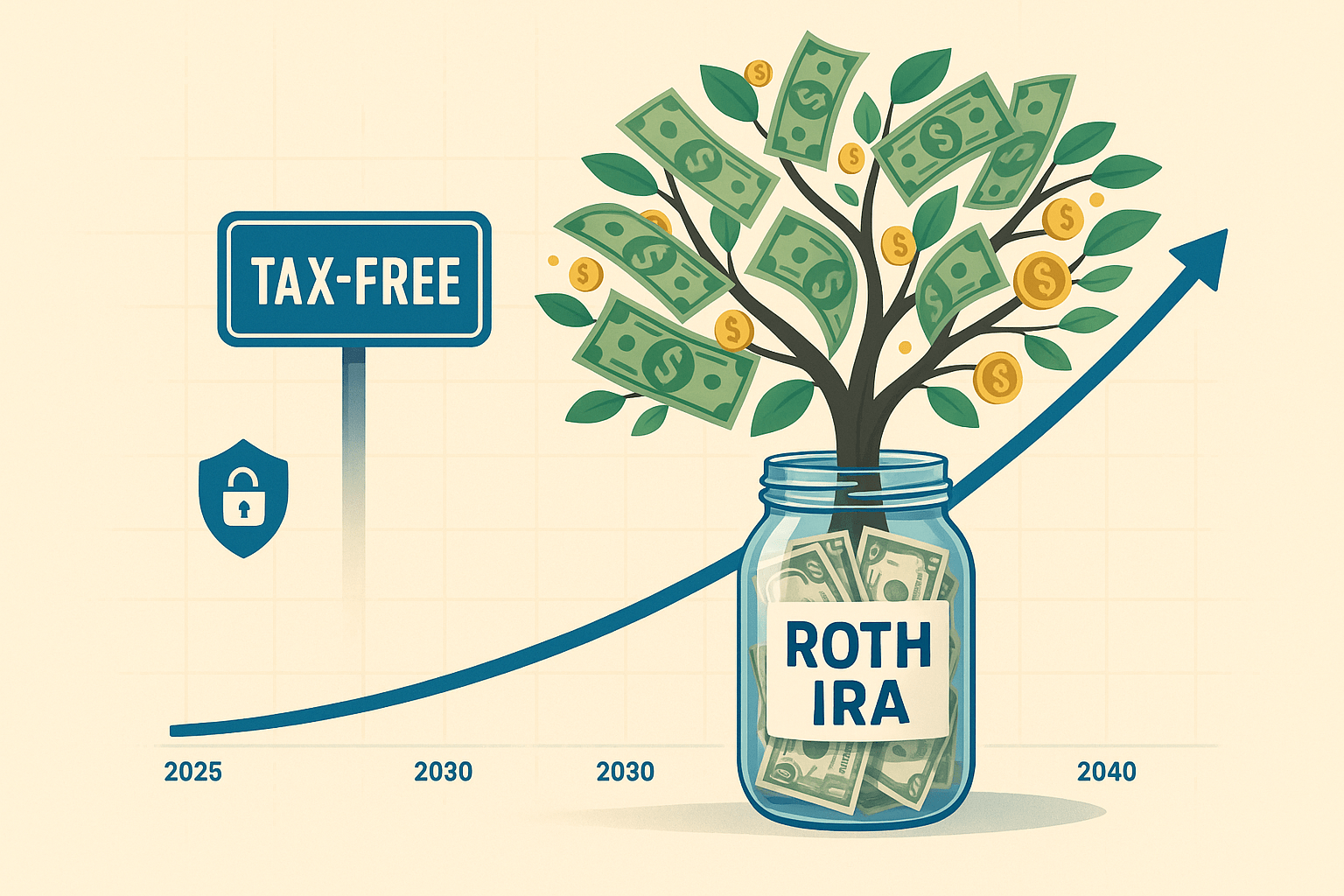
Roth conversions remain one of the most flexible, durable tools in a financial planner’s kit: you volunteer to pay income tax now to move money from a pre-tax IRA/401(k) into a Roth account, trading today’s bill for tomorrow’s tax-free growth and tax-free qualified withdrawals. What’s different in 2025 is the legal backdrop and a few moving parts—Medicare premiums, new Medicare Part D caps, and the post-“One Big Beautiful Bill” (OBBB) tax environment—all of which can subtly change the math on when to convert and how much to convert. Below I’ll walk through the mechanics, rules, planning windows, and edge cases worth knowing this year.
Quick refresher: what a Roth conversion is—and isn’t
A Roth conversion moves dollars from a pre-tax account (traditional IRA, pre-tax 401(k), etc.) into a Roth IRA (or Roth employer plan). The converted amount is taxed as ordinary income in the conversion year. After conversion, future growth and qualified withdrawals from the Roth are tax-free. You can do partial conversions; there’s no cap and no income limit on conversions. You report the conversion on Form 8606, which tracks your IRA basis and calculates the taxable portion. IRS
Key distribution ordering and “five-year” nuances: Roth contributions come out first (always tax- and penalty-free). Converted principal comes out next. Converted dollars have their own separate 5-year penalty clock—withdraw them within five years and before age 59½, and the 10% penalty can apply (even though the amount was already taxed at conversion). Earnings are last out and require both age 59½ (or another exception) and a 5-tax-year aging period since your first Roth IRA to be tax-free. See IRS Pub. 590-B for the official ordering rules and the conversion five-year rule. IRS+1
Two things conversions are not:
- They are not subject to the 3.8% Net Investment Income Tax (NIIT) themselves (IRA distributions aren’t NIIT income), but the extra income from converting can push other investment income over the NIIT threshold. Legal Information InstituteIRS
- They are not reversible anymore. The TCJA eliminated recharacterization of conversions for 2018 and later. (You can still recharacterize a current-year contribution, just not a conversion.) IRS+1
The 2025 rules that matter most
1) RMD ages and the Roth 401(k)/403(b) fix
The SECURE 2.0 Act pushed required minimum distributions (RMDs) to age 73 now and 75 in 2033. Roth IRAs never had lifetime RMDs for owners; and as of 2024, designated Roth accounts in employer plans (Roth 401(k)/403(b)) also no longer require lifetime RMDs. This makes in-plan Roth money much more Roth-IRA-like. HumanaIRS
2) Catch-up contributions and “Roth-only” for high earners—timing
SECURE 2.0 requires age-50+ catch-up contributions for certain high earners (>$145,000 of prior-year wages, indexed) to be Roth only, but the IRS created an administrative transition period through 2025. The Roth-only mandate now begins in 2026. For 2025, normal catch-ups continue; “super catch-ups” for ages 60–63 are available if your plan offers them. IRSHolland & Knight
3) Employer matches can be Roth now
Plans may let participants elect employer matching/nonelective contributions as Roth (taxed now, then grow/withdraw tax-free if qualified). This is optional for plans and guided by IRS Notice 2024-02 and subsequent IRS guidance. IRSMercer
4) Contribution limits (IRA) in 2025
Traditional/Roth IRA contribution limit remains $7,000 (or $8,000 if 50+). The Roth IRA income phase-outs are $150,000–$165,000 (single/HOH) and $236,000–$246,000 (MFJ). If your income is too high to contribute directly, the “backdoor Roth” (nondeductible IRA contribution + conversion) remains permitted. IRS+1
5) The “One Big Beautiful Bill” (OBBB) and the 2025-2028 tax landscape
OBBB (Public Law per Congress.gov) was signed July 4, 2025. Among many items, IRS guidance reflects:
- Standard deduction amounts (2025) are $15,750 (single), $31,500 (MFJ), $23,625 (HOH), plus a new $6,000 “senior standard deduction” for those 65+—figures that affect how much income you can absorb with a conversion and still stay within a target bracket. H&R Block Tax preparation companyIRS
- Media coverage emphasizes interactions with SALT and other itemized limits that may change effective marginal rates for some households in 2025–2028, which can indirectly affect optimal conversion sizing. (Details vary by filer.) The Wall Street Journal
Bottom line: today’s brackets/deductions (as modified by OBBB) may be more favorable than in the early 2030s; that’s an argument for measured conversions in your lower-tax years.
6) Medicare costs and IRMAA in 2025
- Part B base premium is $185.00/month in 2025. IRMAA surcharges can raise that up to $628.90/month at the top bracket. Your 2025 Medicare premiums generally reflect 2023 MAGI (two-year lookback). KFFHealth System Tracker
- Part D redesign starts Jan 1, 2025: out-of-pocket costs capped at $2,000 per year, with a $590 max standard deductible and a new Prescription Payment Plan to spread costs through the year. (Base beneficiary premium is $36.78 for 2025.) Centers for Medicare & Medicaid ServicesMedicareIRS
Planning implication: A large Roth conversion in or after age 63 (which flows into MAGI used two years later) can trigger IRMAA surcharges. Modeling conversions against IRMAA brackets is essential.
7) ACA marketplace subsidies (pre-65 retirees)
Enhanced ACA premium tax credits under the Inflation Reduction Act run through 2025. Without further action, they’re scheduled to expire for 2026 coverage, which could raise net premiums for many early retirees who rely on the exchanges. Conversions increase MAGI and can reduce subsidies; be careful sizing conversions if you’re on ACA coverage before Medicare. Congress.gov+1
8) QCDs and charitable coordination
Qualified Charitable Distributions (QCDs) from IRAs remain a powerful way to fulfill RMDs without raising AGI. The QCD annual limit is $108,000 per person in 2025 (indexed), with a one-time $54,000 allowance to fund certain split-interest gifts. These figures matter when comparing “convert to Roth” vs. “leave pre-tax and use QCDs in RMD years.” IRSEd Slott and Company, LLC
Mechanics that trip people up
The pro-rata rule (aggregation rule)
If you own any pre-tax IRA dollars (traditional, SEP, SIMPLE), every conversion is taxed pro-rata across pre-tax and after-tax basis—there’s no cherry-picking “just the after-tax dollars.” You track basis and calculate the taxable share on Form 8606 each year. Centers for Medicare & Medicaid Services
Backdoor vs. mega-backdoor Roths
- Backdoor Roth: contribute nondeductible to a traditional IRA, then convert. The pro-rata rule still applies across all your IRAs. Centers for Medicare & Medicaid Services
- Mega-backdoor Roth: make after-tax contributions to a 401(k) and move those dollars to Roth (in-plan or to a Roth IRA). IRS Notice 2014-54 allows allocating the after-tax basis to Roth while sending pre-tax amounts to a traditional account in a single distribution. Rhame & Gorrell Wealth Management
Converting from employer plans
Direct rollovers from a pre-tax 401(k)/403(b) to a Roth IRA are permitted and taxable. Rolling after-tax subaccounts out of a plan to Roth while sending the pre-tax to traditional is also supported under Notice 2014-54 (the “split rollover”). Rhame & Gorrell Wealth Management
Strategy in 2025: when (and how much) to convert
The “bridge years” sweet spot
The most conversion-friendly window is often after you stop working (or cut hours) but before RMDs and before/after Social Security depending on your plan. With the OBBB standard deductions and current bracket structure through at least 2028, many households find room each year to “top off” a target bracket with conversions—especially between retirement and age 73. H&R Block Tax preparation company
Watch the Medicare and ACA cliffs
- Medicare IRMAA uses MAGI from two years prior and has discrete brackets. A $1 overage can trigger hundreds of dollars per month in premiums, so partial conversions that stay just below an IRMAA tier are often optimal. SSA’s SSA-44 appeal process can reduce IRMAA after “life-changing” events (e.g., retirement), but you still plan ahead. Social SecuritySocial Security Administration
- ACA subsidies (pre-65) are highly MAGI-sensitive. Through 2025, enhanced credits can be generous; a large conversion can sharply reduce the subsidy. If you’ll rely on ACA for 2026, build scenarios for “with” and “without” enhanced credits. IRSCongress.gov
Don’t trigger taxes you don’t need to
- The 3.8% NIIT doesn’t apply to IRA distributions/conversions per se, but conversions can raise MAGI so that other investment income becomes exposed to NIIT. Model this, particularly if you have significant dividends/capital gains. Legal Information Institute
- Coordinate conversions with charitable strategies. If you’re charitably inclined, QCDs in RMD years can be “better than Roth” because they keep income out of AGI entirely—useful for IRMAA, NIIT, and Social Security taxation thresholds. The higher 2025 QCD limit widens that lever. Ed Slott and Company, LLC
Pay the tax bill with outside cash whenever possible
Using the converted IRA itself to pay the tax undercuts the benefit and can even trigger the 10% penalty if you’re under 59½. Funding the tax from a taxable account usually preserves more Roth assets compounding tax-free. (This is standard best practice reflected across IRS and industry guidance.) Investopedia
Advanced edges & lesser-known rules
Inherited IRAs: Post-SECURE rules generally require most non-spouse beneficiaries to empty the account by the end of year 10 after death (with special rules for certain “eligible designated beneficiaries”). The IRS’s pandemic-era RMD penalty relief for some inherited-IRA beneficiaries ended; 2025 is the first year with the system “fully on.” If you inherit a Roth IRA, you still must empty it by year 10, but the money can grow tax-free in the meantime (and the owner had no lifetime RMDs). IRSBarron’s
529-to-Roth rollovers (since 2024): A long-held 529 can be rolled into the beneficiary’s Roth IRA within strict limits (15-year rule, annual IRA limits apply, lifetime cap). This isn’t a conversion from a pre-tax IRA, but it’s a Roth-funding pathway that became available under SECURE 2.0. IRS
Employer plan “Roth matches”: If your plan offers Roth employer contributions, remember those dollars are taxed in the year contributed (unlike traditional matches) and not subject to FICA/Medicare withholding, per IRS guidance. This can slightly alter your optimal conversion/cash-flow plan. IRS
A step-by-step game plan for 2025
- Map the brackets and cliffs first. List your projected 2025–2028 income, then layer in a conversion until you “fill” the target bracket without crossing IRMAA tiers (2027 premiums will reflect 2025 MAGI). Health System Tracker
- Sequence with benefits: If you’re 63+, consider splitting a planned conversion across two years to avoid a large single-year IRMAA hit. If you’re pre-65 on ACA, measure the subsidy impact. IRS
- Mind pro-rata/8606: If you have pre-tax IRA balances and you’re attempting backdoor Roths, consider “clearing” pre-tax IRA money into a 401(k) (if permitted) to isolate basis before converting. File Form 8606 accurately. Centers for Medicare & Medicaid Services
- Pay taxes from taxable assets. Stress-test your liquidity; don’t shrink the Roth you just built. Investopedia
- Coordinate with charitable giving. In RMD years, compare partial conversions now vs. larger QCDs later. With the 2025 QCD limit at $108,000, heavy givers often prefer keeping some assets pre-tax to fund QCDs efficiently. Ed Slott and Company, LLC
- Keep documentation clean. Use direct trustee-to-trustee moves. If you’re doing mega-backdoor tactics, follow Notice 2014-54 allocation rules precisely when splitting pre-tax/after-tax dollars. Rhame & Gorrell Wealth Management
Who tends to benefit most from conversions?
- New retirees with several low-income years before RMDs/Social Security—classic window to shift money to Roth at lower rates.
- Surviving spouses anticipating a later switch to single tax brackets (often higher for the same income), and higher IRMAA exposure.
- Families focused on heirs in higher tax brackets; Roth inherits cleanly (no income tax for qualified distributions to beneficiaries, though the 10-year rule still applies). IRS
Who may not benefit—or should convert modestly:
- ACA-reliant early retirees whose subsidies would drop sharply with higher MAGI. IRS
- Those planning to do significant QCDs in RMD years; leaving some dollars pre-tax may beat converting them first. Ed Slott and Company, LLC
- Anyone cash-poor; paying the tax from the IRA itself weakens the math and risks penalties <59½. IRS
2025 checklist (print this)
- Confirm your filing status, standard deduction, and (if 65+) the new senior standard deduction. IRS
- Verify Roth IRA income phase-outs and your ability to contribute vs. using a backdoor. IRS
- If 50+, check your plan’s stance on catch-ups for 2025 and whether Roth-only will trigger for you in 2026. IRS
- If 63+, model the IRMAA impact for 2027 (based on 2025 MAGI). Health System Tracker
- If on ACA pre-65, model what a 2025 conversion does to your 2025 subsidy—and note that enhanced credits are scheduled to end for 2026. Congress.gov
- If charitably inclined, decide whether you’ll use QCDs later instead of converting now. 2025 QCD limit is $108,000. Ed Slott and Company, LLC
- Keep conversions direct (trustee-to-trustee), and keep Form 8606 clean. Centers for Medicare & Medicaid Services
The future: what might change next?
Between now and the early 2030s, the most likely swing factors are ordinary-income brackets/deductions and healthcare-cost policy (ACA subsidies/Medicare premiums). OBBB set the near-term table, but sunset dynamics and future legislation could still move the goalposts. Because conversions are irrevocable, I favor an annual, incremental approach—fill brackets year by year, keeping an eye on IRMAA/ACA thresholds and your charitable plans—rather than “all-in” conversions unless there’s an unusually compelling reason. H&R Block Tax preparation companyThe Wall Street Journal