A Practical Guide to Disaster Preparedness (for Households & Small Businesses)
If a recession is a slow-moving storm, disasters are its fast, messy cousin. Hurricanes, floods, wildfires, winter storms, tornadoes, earthquakes, extreme heat, chemical spills—every U.S. county faces something. The good news: a little planning now saves money, time, and heartache later. This guide gives you a CPA-level, step-by-step plan that’s thorough and easy to implement—tailored for households and small businesses.
1) Know Your Risks (so you prep the right way)
Start with the hazards most likely where you live and work:
- Hurricanes & coastal storms (Atlantic, Gulf, and parts of the Pacific) — prep for wind, surge, and long power outages. Use local evacuation zone maps every season. Small Business Administration
- Floods (everywhere, often outside “flood zones”) — never drive through water; “Turn Around, Don’t Drown.” Consider a flood policy even if you’re not mapped high-risk. Disaster Assistance+2IRS+2
- Wildfires (West, Great Plains, expanding East) — create defensible space and harden roofs/vents. Congress.gov
- Tornadoes & severe thunderstorms (most states) — identify your safest interior, windowless room on the lowest level. Ready.gov
- Earthquakes (West Coast, Alaska, New Madrid region, more) — practice “Drop, Cover, and Hold On.” USGS
- Extreme heat & winter weather — heat kills more people than you think; winter storms cause long outages. Ready.gov
Add local intel: your state emergency management office and FEMA’s location search list current/past declarations, local contacts, and hazard pages. Bookmark them now. USAGov+1
2) Build Layered Readiness: Go-Bag, Home Stock, and Car Kit
Your 3-Tier Kit Strategy
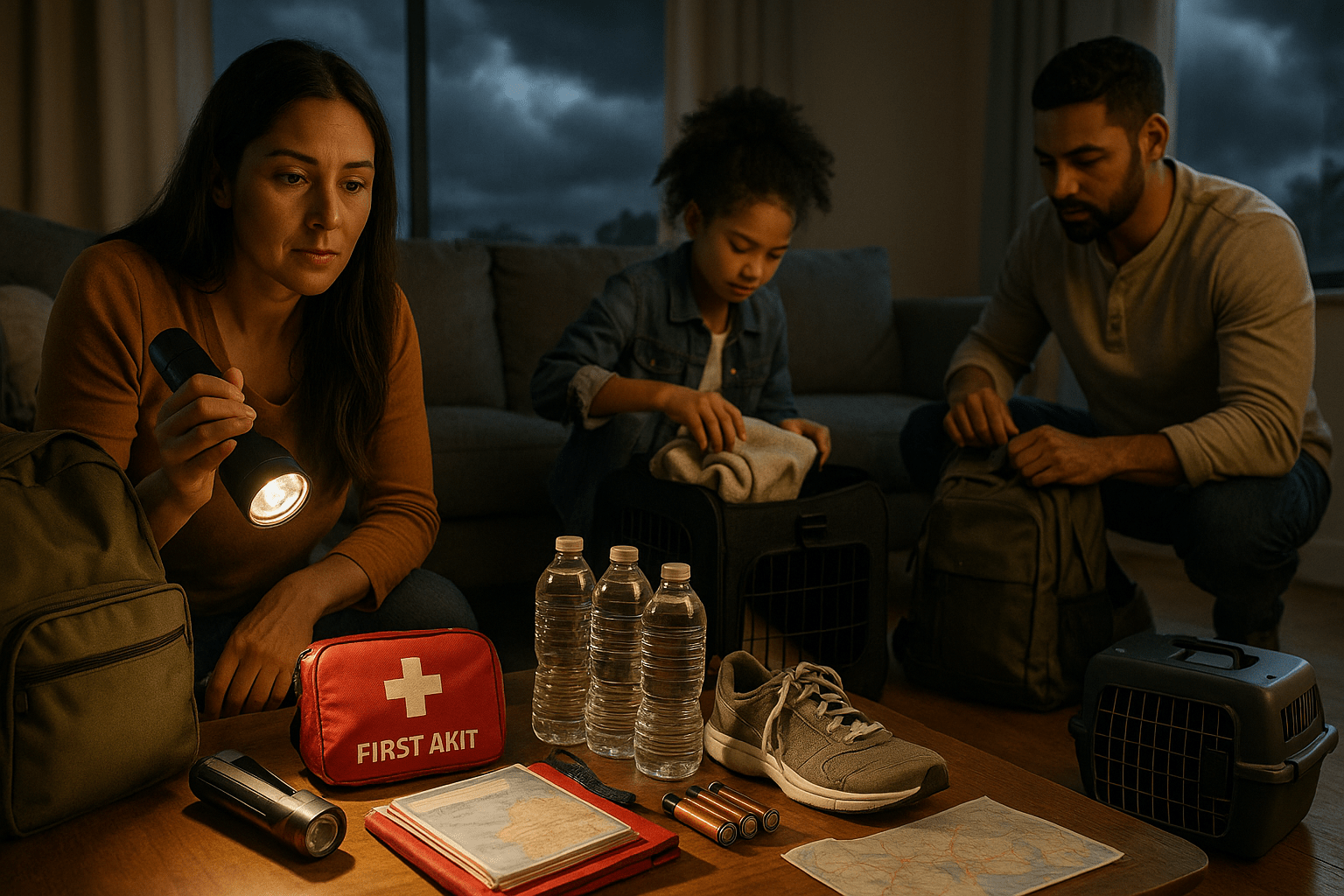
A) Go-bag (grab-and-go, for 3 days)
B) Home stock (aim for 3–7 days minimum; 2+ weeks if you can)
C) Car kit (24 hours)
Use FEMA’s official supply list as your baseline and store at least one gallon of water per person per day for several days (drinking & sanitation). Add a NOAA Weather Radio and keep supplies in easy-to-carry containers. Ready.gov
Household essentials (pack once, review yearly):
- Water & non-perishable food (manual can-opener)
- Battery or hand-crank radio and NOAA Weather Radio
- Flashlights, headlamps, spare batteries
- First-aid kit; 7–14 days of prescriptions & key OTC meds
- Sanitation: moist towelettes, garbage bags, hygiene items
- Multitool/wrench (to turn off utilities), work gloves, dust masks
- Copies of IDs/insurance/policies (waterproof pouch) + USB and cloud backup
- Phone chargers, battery bank; some cash in small bills
- Seasonal clothing, sturdy shoes; blankets/sleeping bags
(Full FEMA list and printable checklist here.) Ready.gov
Food safety in outages: Keep fridge/freezer closed. Food stays safe ~4 hours in a refrigerator, ~48 hours in a full freezer (~24 hours half-full). When in doubt, throw it out. CDC+1
Water safety in advisories: Follow local instructions. Typical boil water guidance is a rolling boil for at least 1 minute (longer at altitude); do not use untreated tap water for brushing teeth or making baby formula. CDC+1
3) Stay Informed: Alerts That Find You
- Wireless Emergency Alerts (WEA): Free, geo-targeted alerts sent to most smartphones. Keep them ON. (Imminent threats, evacuation orders, AMBER, etc.) Federal Communications Commission+1
- NOAA Weather Radio (NWR): 24/7 official warnings direct from the National Weather Service—often the fastest for tornado/flood warnings and overnight threats. Get a radio with a tone alarm + battery backup. National Weather Service+1
- FEMA App: Real-time alerts, hazard guides, and nearby emergency shelters when activated. FEMA
4) Make a Family & Team Plan (15 minutes that pays off)
- Two meeting places: one near home, one out-of-neighborhood.
- Out-of-area contact: If local lines jam, everyone texts one person out of state.
- Routes & options: Know your evacuation zone, bridges, flood routes, and backroads.
- Role cards: Who grabs the go-bags, who secures pets, who shuts off utilities?
- Copies: Put the plan in everyone’s phone and print copies.
Use FEMA’s Make-a-Plan forms and financial documents checklists—there’s even a checklist from CFPB for vital records and accounts. Ready.gov
5) Financial Preparedness (where the CPA voice kicks in)
The 5-Document Rule
Create a waterproof pouch and a cloud folder containing:
- IDs (driver’s license, Social Security cards, passports)
- Insurance (home/renters, auto, health, life, flood, earthquake if applicable)
- Property & finance (deeds, titles, mortgage/lease, bank/credit/card info)
- Medical (prescriptions, allergies, vaccination records)
- Business docs (EIN, registrations, leases, payroll, vendor/customer lists)
Use FEMA & Operation HOPE’s Emergency Financial First Aid Kit (EFFAK) to organize everything (fillable forms available). Ready.gov+1
Insurance tune-up (before the storm season):
- Homeowners/Renters ≠ Flood: NFIP flood insurance is usually separate and has a 30-day waiting period (no last-minute purchases). Even low-risk areas flood. IRS+1
- Wind/hurricane deductibles: Check your policy; coastal policies often have % deductibles.
- Earthquake coverage: Typically a separate policy/endorsement.
- Business interruption insurance: Ask your broker if it fits your risk & margins.
- Home inventory: A 20-minute phone video of every room (open drawers/closets) + receipts/photos in your cloud folder.
Cash, credit, and continuity:
- Emergency fund: 1–2 paychecks in instantly accessible cash equivalents; ATMs and card networks can go down.
- Payments & billing: List every monthly bill and set up hardship options (mortgage servicer, utilities, telecom).
- Backups: Scan receipts, warranties, insurance declarations, and put them in cloud storage with MFA.
Taxes after a federally declared disaster:
- The IRS often postpones deadlines and lets you claim certain casualty losses on Form 4684; you may elect to claim the loss on last year’s return to get cash faster. Rules are specific—check the IRS’s disaster page and Publication 547. (Get a CPA involved—this is worth it.) Floodsmart+1
6) Special Planning: Kids, Older Adults, Disabilities & Pets
- People with disabilities or access/functional needs: Build a support network, label equipment, and plan transportation/backup power for medical devices. Keep a kit sized for easy transport. Ready.gov+1
- Pets: Not all shelters take animals—identify pet-friendly shelters/hotels now; have carriers, leashes, vaccination records, a 3–7 day pet kit, and microchip info. Ready.gov+1
7) Hazard-Specific “Do-This-Now” Playbooks
Hurricanes
- Know your zone and routes. If officials order evacuation, go.
- Fuel up, charge devices, and secure outdoor items 48–24 hours prior.
- Expect long power/water outages; be self-sufficient for several days. Small Business Administration
Tornadoes & Severe Storms
- Identify a small, interior, windowless room on the lowest level (or a FEMA-rated safe room). Helmets for kids are smart. Practice getting there in under 30 seconds. Ready.gov
Wildfires
- Create defensible space (clear debris, limb trees away from roof); prepare go-bags and set “leave at Ready, Set, Go.” Keep N95s in the kit for smoke. Congress.gov
Earthquakes
- Practice Drop, Cover, and Hold On. Secure bookcases/water heaters; keep shoes next to the bed. USGS
Floods
- Sign up for NWS alerts, keep a flashlight by your bed, and never drive through water. Six inches can stall a car, 12 inches can float it. Consider flood insurance even off the map. National Weather Service+2IRS+2
Extreme Heat & Winter Storms
- Heat: hydrate, check on neighbors, limit mid-day activity.
- Winter: prep safe heat sources, carbon monoxide detectors, and a 72-hour car kit. Ready.gov
8) Small-Business Corner: Keep the Lights On (Even When They’re Off)
A simple, written business continuity plan protects revenue, customers, and payroll.
Your continuity checklist:
- People: Updated contacts, phone tree, and cross-training.
- Data: Daily cloud backups + offsite copy, MFA on all accounts.
- Facilities: Alternate workspace, vendor agreements, and critical spares.
- Finance: Emergency credit line; list of essential payables/receivables.
- Comms: Pre-written customer notices; status page or pinned social post.
Use FEMA’s Ready Business toolkits to build and test your plan, then review quarterly. Disaster Assistance
If you’re hit: The U.S. Small Business Administration (SBA) offers low-interest Physical Disaster Loans (repair/replace real estate, equipment, inventory) and Economic Injury Disaster Loans (EIDL) for working capital when revenues drop after a declared disaster. Homeowners and renters may qualify for Home & Personal Property disaster loans as well. Apply promptly; interest rates and terms are posted on SBA’s site for each declaration. American Bar Association+2iiimef.marines.mil+2
9) Where to Get Help—Fast
Federal & national resources
- DisasterAssistance.gov — one-stop for FEMA aid, status checks, and links to state/local help; or apply via the FEMA App or by phone (800-621-FEMA). Disaster Assistance+1
- FEMA Disaster Recovery Centers (DRCs) — in-person help after a declaration; use the DRC Locator (you can even text “DRC” + your ZIP). egateway.fema.gov+1
- SBA Disaster Loans — physical damage and economic injury assistance for businesses, certain nonprofits, homeowners/renters. American Bar Association+2iiimef.marines.mil+2
- USDA’s Disaster SNAP (D-SNAP) — temporary food benefits for eligible households after declared disasters, administered by states when authorized. Food and Nutrition Service+1
- 211 (United Way/partners) — dial 2-1-1 to reach a local specialist for shelters, food, housing, mental health, and more (available in 99% of the U.S.). 211+1
- Rx Open (Healthcare Ready) — map of open pharmacies during disasters. Healthcare Ready+1
- NOAA Weather Radio (NWR) — 24/7 official alerts; consider it your backup when cell/data fail. National Weather Service
State & local
- Your state emergency management agency (websites list county offices, local alerts, hazard pages). USAGov
- Local county/city emergency management and health departments (water advisories, shelter sites, road closures).
- Community & faith groups coordinated through 211 and local VOAD partners (case management, cleanup, food).
Tax & legal
- IRS Disaster Relief & Publication 547 for casualty losses and postponed deadlines; consult a CPA for optimizing elections (e.g., prior-year claim). Floodsmart+1
10) Quick-Start: 30-60-Weekend Plan
In 30 minutes (today):
- Turn on WEA alerts on your phone; download the FEMA App; put fresh batteries in your NOAA Weather Radio. Federal Communications Commission+2FEMA+2
- Pick two meeting places + one out-of-area contact.
- Fill two gallon jugs and stash them; throw a flashlight and small first-aid kit into a backpack.
In 60 minutes (this week):
- Assemble the go-bag using FEMA’s supply list (add meds, chargers, a photocopy of IDs/insurance). Ready.gov
- Do a home video inventory (one take, room-by-room).
- Make a cloud folder for vital documents; scan what you have.
Over a weekend (this month):
- Review insurance, especially flood and special deductibles; talk to your agent. IRS+1
- Complete the EFFAK (financial first aid kit) and store a waterproof pouch in your go-bag. Ready.gov+1
- Build 3–7 days of home supplies; rotate quarterly. Ready.gov
- If you’re a business owner, download a Ready Business toolkit and draft your continuity plan. Disaster Assistance
11) Post-Disaster Recovery: First 48 Hours
- Safety first: Watch for hazards (downed lines, gas leaks, floodwater).
- Document damage: Photos/video before cleanup; save receipts.
- Contact insurers & apply for aid: File claims; apply at DisasterAssistance.gov; visit a DRC if you need hands-on help. Disaster Assistance+1
- Food & water safety: Follow CDC/EPA guidance on discarding perishable foods and boiling/disinfecting water. CDC+1
- Medications: Use Rx Open to find an operating pharmacy if yours is closed. Healthcare Ready
- Financial triage: Pause non-essentials, contact lenders about hardship/forbearance, and talk to your CPA about IRS relief windows. Floodsmart
12) Final Word (and a Calm Nudge)
Disaster readiness isn’t about fear—it’s about autonomy. A few hours of prep buys you independence when systems are strained. Start small, stack wins, and revisit quarterly. If you do nothing else today, turn on alerts, download the FEMA App, fill two gallons of water, and print your EFFAK forms. Your future self—and your bottom line—will thank you. Federal Communications Commission+2FEMA+2
Handy Links (save/bookmark)
- Build a kit (official checklist): FEMA Ready.gov → Build A Kit. Ready.gov
- Organize your finances: EFFAK (Emergency Financial First Aid Kit). Ready.gov
- Real-time alerts & shelters: FEMA App. FEMA
- Flood insurance basics & waiting periods: FloodSmart.gov. IRS+1
- Federal aid gateway: DisasterAssistance.gov (FEMA, SBA, more). Disaster Assistance
- State emergency management directory. USAGov
- Disaster SNAP (food aid) info. Food and Nutrition Service
- Find open pharmacies: Rx Open. Healthcare Ready
- NOAA Weather Radio (buy one; program your county codes). National Weather Service
This guide is educational and not tax, legal, or insurance advice. For personalized guidance, work with your CPA (hi 👋), attorney, and licensed insurance agent.