An emergency fund is one of the least exciting financial accounts you will ever open.
Until the day you need it.
The transmission fails.
The air conditioner quits in July.
The dog needs emergency veterinary care.
Your employer cuts hours.
A medical bill arrives that you were not expecting.
Or your income simply stops for a while.
Without cash available, an inconvenience can quickly turn into credit-card debt, a personal loan, a retirement-account withdrawal, or a string of late payments.
That is what an emergency fund is designed to prevent.
But there is another side to the story that deserves more attention:
Your emergency money does not have to sit in an account earning almost nothing while it waits for something to go wrong.
A properly structured emergency fund can remain safe, accessible, and separate from your everyday spending while still earning interest.
And in today’s higher-interest-rate environment, the difference can be meaningful.
Here is how to build one from scratch—or improve the one you already have.
- First, Understand What an Emergency Fund Is
An emergency fund is money specifically reserved for unplanned, necessary expenses or a temporary loss of income.
The Consumer Financial Protection Bureau describes emergency savings as a dedicated cash reserve for financial shocks such as car repairs, home repairs, medical expenses, or lost income. Even a relatively small reserve can reduce the likelihood that an unexpected expense turns into expensive debt.
The important word is unexpected.
Your annual property-tax bill is not an emergency if you knew it was coming.
Neither is Christmas.
Neither is a vacation.
Neither is replacing a vehicle you already know is reaching the end of its useful life.
Those are expenses that should generally have their own planned savings.
A useful test is to ask three questions:
Was it unexpected? Is it necessary? Does it need to be dealt with reasonably soon?
If the answer is yes to all three, you are probably looking at the kind of expense an emergency fund was built to handle.
- There Is No Magic Emergency-Fund Number
You will often hear:
“Save three to six months of expenses.”
That is a useful rule of thumb.
It is not a law of personal finance.
The CFPB takes a more practical position: the right amount depends on your particular circumstances and the kinds of financial shocks you are likely to encounter.
Someone with two stable household incomes, excellent health insurance, a newer car, and low fixed expenses may reasonably need a smaller reserve than someone who is self-employed, supports a family on one income, owns an older home, or has highly variable earnings.
A better approach is to build your fund in stages.
Stage One: Build a Starter Emergency Fund
Your first goal does not have to be $20,000.
Start with enough money to absorb one realistic problem without reaching for a credit card.
For some households, $500 may make an enormous difference.
For others, $1,000 or $2,000 may be a more useful first milestone.
Think about the kinds of surprises you have actually experienced.
What would a normal car repair cost?
What is your health-insurance deductible?
How much would an emergency home repair likely require?
The point is not finding a perfect number.
The point is moving from:
“I have no financial cushion.”
to:
“I can handle at least one problem.”
That is a meaningful improvement.
- Next, Calculate One Month of Essential Expenses
Once you have a starter fund, determine what it actually costs to keep your household functioning for one month.
Do not simply use your normal monthly spending.
Separate essential expenses from discretionary spending.
For example:
Essential Expense Monthly Amount
Mortgage or rent $1,400
Utilities $350
Groceries $650
Insurance $400
Transportation $500
Minimum debt payments $350
Medical/prescriptions $200
Other necessities $150
Total essential expenses $4,000
In this example, one month of core expenses is about $4,000.
That gives you a much more useful planning number.
Three months would be approximately:
$12,000
Six months:
$24,000
You now have an actual target based on your household instead of a generic number from the internet.
- How Many Months Should You Keep?
This is where personal circumstances matter.
Someone with extremely stable employment, two earners, little debt, and strong insurance coverage may be comfortable toward the lower end of the range.
Someone whose finances are less predictable may want substantially more.
Consider building a larger reserve if your household depends on one income, you are self-employed, your income is commission-based or seasonal, you own rental property, you have significant medical exposure, your profession could take months to replace after a layoff, you support dependents, or your home and vehicles are likely to generate expensive repairs.
A self-employed consultant whose income can swing wildly from month to month may reasonably sleep better with nine months of essential expenses.
A dual-income household in stable jobs may feel adequately protected with considerably less.
The best emergency fund is not the one somebody else says you should have. It is the one large enough to keep your household financially stable when something goes wrong.
- Where Should the Money Actually Go?
An emergency fund has three jobs:
Protect the principal.
Remain accessible.
Earn a reasonable return without taking unnecessary risk.
That is why an emergency fund generally does not belong in stocks, cryptocurrency, or other investments whose value can fall precisely when you need the money.
For most households, a federally insured savings account is an excellent starting point.
And that brings us to high-yield savings accounts.
- What Is a High-Yield Savings Account?
A high-yield savings account, commonly called an HYSA, is essentially a savings account that pays a comparatively competitive interest rate.
“High yield” is mostly a marketing description. It is not a special federal account category.
Many high-yield accounts are offered by online banks, although traditional banks and credit unions can offer competitive savings products as well.
The important number to compare is usually the:
APY — Annual Percentage Yield
APY reflects the amount you could earn over a year, including the effect of compounding, assuming the rate and balance remain unchanged.
Suppose you keep $10,000 in an account paying:
APY Approximate Annual Interest*
0.50% $50
2.00% $200
4.00% $400
*Assuming the balance remains around $10,000 and the quoted APY remains unchanged for the year.
An extra $350 may not change your life.
But why voluntarily give it up if another equally suitable insured account pays substantially more?
- Today’s Rate Environment Makes Shopping Around Worthwhile
On September 16, 2026, the Federal Reserve increased its target range for the federal funds rate to 3.75%–4.00%. Short-term interest rates influence what financial institutions can earn and what many are willing to pay depositors, although banks are not required to move savings rates in lockstep with the Fed.
That means the rate on your savings account deserves periodic attention.
But there is an important lesson here:
Do not chase an account simply because today’s APY is slightly higher.
Savings rates are generally variable.
A bank paying a very attractive rate today can lower it later.
The better account is usually the one offering a competitive yield plus good access, reasonable terms, federal insurance, no troublesome fees, and a banking arrangement you understand.
- Compare More Than the APY
A flashy APY at the top of a website is not enough information.
Before opening a high-yield savings account, look at the whole account.
What to Check Why It Matters
APY Determines how competitively your money earns
Minimum balance Some advertised rates require certain balances
Monthly fees Fees can erase part of the interest
Transfer speed Emergency money needs to be reachable
ATM access Useful depending on how you expect to access funds
Withdrawal rules Banks may impose account-specific limits or fees
Introductory rate A promotional APY may eventually disappear
Deposit insurance Critical for protecting the principal
Customer service Becomes very important when money is urgently needed
Linked checking Can simplify emergency transfers
A difference of 0.10% or 0.20% in APY is rarely worth moving your entire financial life to an institution you dislike.
The objective is not to win an APY contest.
The objective is to have safe money available when life goes sideways.
- Make Sure the Money Is Actually Federally Insured
This is one of the most important parts of the entire article.
For an FDIC-insured bank, the standard insurance amount is currently:
$250,000 per depositor, per insured bank, per ownership category.
That does not simply mean “$250,000 per account.”
Multiple accounts owned by the same person in the same ownership category at the same bank are generally combined for purposes of determining insurance coverage. Different ownership categories can receive separate coverage when the applicable requirements are satisfied.
At federally insured credit unions, the National Credit Union Share Insurance Fund provides comparable basic protection, generally up to $250,000 per member-owner in applicable ownership categories.
For most ordinary emergency funds, these limits are far above the account balance.
Still, verify the institution.
Do not assume a company is insured simply because its website looks like a bank.
- Be Particularly Careful With Fintech Savings Apps
This has become increasingly important.
Some financial apps look and function much like banks but are actually nonbank financial-technology companies.
The FDIC specifically warns that nonbank companies themselves are never FDIC-insured.
A fintech may place customer money at one or more FDIC-insured partner banks, potentially allowing qualifying deposits to receive pass-through coverage—but certain conditions must be met, including proper records identifying the actual owners of the funds. FDIC insurance also protects against failure of the insured bank; it does not insure you against bankruptcy of the nonbank company itself.
Before using an app as the home of your emergency fund, find out:
Who is the actual bank holding my money?
Then verify that bank through the FDIC.
For money you may need immediately to pay the mortgage or repair the car, simplicity and certainty have real value.
- Money Market Account or Money Market Fund? They Are Not the Same
The names are confusing.
A money market deposit account at an FDIC-insured bank is a deposit account and can receive FDIC insurance subject to applicable limits.
A money market mutual fund is an investment.
It is not FDIC-insured.
The SEC describes money market funds as mutual funds that invest in short-term securities. They are generally considered relatively low-risk investments, but they are not guaranteed by the FDIC and it is possible to lose money.
That does not make money market funds bad products.
It simply makes them different products.
If your objective is the safest, simplest possible home for money you may need tonight, understand exactly which one you are using.
- What About CDs?
Certificates of deposit can sometimes pay attractive rates and are FDIC-insured when held as deposits at an insured bank within applicable limits.
But a traditional CD typically requires you to commit the money for a specified period, and early withdrawals may carry a penalty.
That can make CDs useful for the outer layer of a larger emergency reserve, but less attractive for the first dollars you may need immediately.
For example, a household with a six-month emergency fund might keep the first two or three months fully liquid in savings and consider placing a portion of the remaining reserve in short CDs.
The important rule is:
Do not lock up the money you are most likely to need first.
- Treasury Bills Can Be Another Secondary Option
Short-term U.S. Treasury securities can also play a role for someone with a larger cash reserve.
Treasury securities are not FDIC-insured because they are not bank deposits, but they are backed by the full faith and credit of the United States government.
Treasury interest is subject to federal income tax but is generally exempt from state and local income taxes.
Still, Treasury bills are not necessarily the ideal location for the first layer of an emergency fund.
Your emergency reserve should be designed around accessibility first.
If the water heater bursts tonight, your first concern should not be figuring out how to liquidate an investment.
- Your Emergency Fund Should Be Separate—but Not Difficult to Reach
There is a behavioral advantage to keeping emergency savings away from everyday checking.
If $15,000 sits beside your debit-card balance every morning, it can slowly begin to feel like spendable money.
A separate savings account creates a small psychological barrier:
“This money has a job.”
But do not make access so difficult that you create another problem.
If transferring money from the emergency account routinely takes several business days, you may want to keep a smaller checking buffer for immediate problems.
A useful structure can be:
Checking account: ordinary bills plus a modest cushion.
High-yield savings: primary emergency reserve.
CDs or Treasury securities: optional outer layer for a larger reserve.
That gives you both access and yield.
- Automate the Fund
The CFPB recommends creating a consistent savings habit and notes that automatic recurring transfers are one of the easier ways to build savings over time.
Automation is powerful because it eliminates a monthly decision.
Suppose you automatically save:
$50 per week.
After one year, you have contributed:
$2,600
before interest.
At $100 per week:
$5,200
At $200 per month:
$2,400
The amount matters.
But the habit matters even more.
A modest automatic transfer that actually happens every payday is more valuable than a grand savings plan you never start.
- Use Windfalls Strategically
Not every dollar has to come from your regular paycheck.
A tax refund, work bonus, overtime check, side-gig income, rebate, gift, or sale of unused property can accelerate the process dramatically.
Suppose your emergency-fund goal is $12,000.
Saving $250 every month takes four years if you start at zero and ignore interest.
But a $2,500 tax refund and a $1,500 work bonus immediately reduce the remaining goal to $8,000.
Now the same $250 monthly contribution reaches the target considerably sooner.
You do not have to save every windfall.
But allocating a portion before the money disappears into normal spending can make a huge difference.
- High-Interest Debt and Emergency Savings Can Coexist
A common financial debate goes something like this:
“Should I build an emergency fund or pay off my credit cards?”
Sometimes the answer is:
Both.
If you put every available dollar toward debt and leave yourself with absolutely no cash reserve, the next $800 emergency may simply go straight back onto the credit card.
That can create a frustrating cycle:
Pay card down.
Emergency happens.
Run card back up.
Repeat.
A reasonable starter emergency fund can provide some protection while you aggressively tackle expensive debt.
Once high-interest debt is under control, you can redirect more cash toward the larger emergency-fund target.
Personal finance does not always require choosing one goal and completely ignoring every other goal.
- Interest Is Usually Taxable
There is another detail people sometimes forget.
Interest earned in a savings account is generally taxable income for federal income-tax purposes.
Banks commonly report taxable interest on Form 1099-INT when the applicable reporting requirements are met, but taxpayers generally must report taxable interest even if they do not receive a Form 1099-INT.
So if your high-yield savings account earns $600 during the year, think of the $600 as income—not free tax-exempt money.
That does not make earning interest undesirable.
Paying tax on income is generally preferable to earning no income at all.
- Should Your Emergency Fund Be Invested in Stocks?
Generally, the core reserve should not depend on the stock market.
Imagine losing your job during a recession.
That may be exactly when:
Your income disappears.
Stocks fall sharply.
And you suddenly need your emergency fund.
If you have to sell investments after a major decline, you have combined two financial problems into one.
Investing is appropriate for long-term goals where you have time to tolerate market swings.
Emergency savings has a different assignment.
Its job is not maximizing long-term wealth. Its job is being there.
That distinction is crucial.
- When Is It Okay to Spend the Emergency Fund?
Using the account is not failure.
That is why you built it.
If the transmission goes out and the car is necessary for work, use it.
If you unexpectedly need a medical procedure, use it.
If you lose your job and need groceries and utilities, use it.
Do not congratulate yourself for having a $20,000 emergency fund while financing a genuine emergency at a 25% credit-card APR simply because you are afraid to touch the savings.
The purpose of an emergency fund is not to preserve a pretty account balance.
It is to protect your financial life.
Once the emergency passes, the next job is simple:
Rebuild it.
- When Should You Not Use It?
An emergency account can slowly turn into an everything account if you are not careful.
A sale at your favorite store is not an emergency.
Concert tickets are not an emergency.
A nicer television is not an emergency.
A vacation opportunity is not an emergency.
A predictable annual insurance premium is not an emergency.
This is why separate sinking funds can be helpful.
You can maintain separate savings for:
Home repairs
Car replacement
Travel
Insurance deductibles
Taxes
Christmas
Then the emergency fund remains reserved for true financial shocks.
- Review the Fund Once a Year
Your target should not be frozen forever.
Life changes.
A $15,000 fund may have represented six months of core expenses when you created it.
Five years later, after buying a house, adding a child, changing insurance plans, and experiencing inflation, it might cover only three months.
Review the account at least annually.
Recalculate your essential monthly expenses.
Check the interest rate.
Confirm the account still has no unwanted fees.
Review the bank’s insurance status.
Make sure beneficiaries and account ownership remain appropriate.
And if your emergency fund is now larger than necessary, consider whether excess money should be directed toward longer-term goals instead.
- Don’t Let Rate Chasing Become a Hobby
Suppose Bank A pays 4.00% APY and Bank B suddenly offers 4.15%.
On a $10,000 balance, the difference is roughly:
$15 per year
if both rates remained unchanged for a year.
Moving accounts, changing automated transfers, creating another tax document, and managing another login may not be worth $15.
Rate shopping matters most when the difference is meaningful.
Moving $20,000 from an account paying 0.25% to one paying 4.00% is potentially worthwhile.
Moving constantly between accounts to chase every tenth of a percentage point is something else entirely.
Optimize intelligently—not obsessively.
- A Simple Emergency-Fund Plan You Can Start Today
Here is the entire process condensed into one practical checklist:
Calculate one month of essential household expenses.
Choose a starter target you can reach quickly.
Decide how many months of expenses make sense for your household.
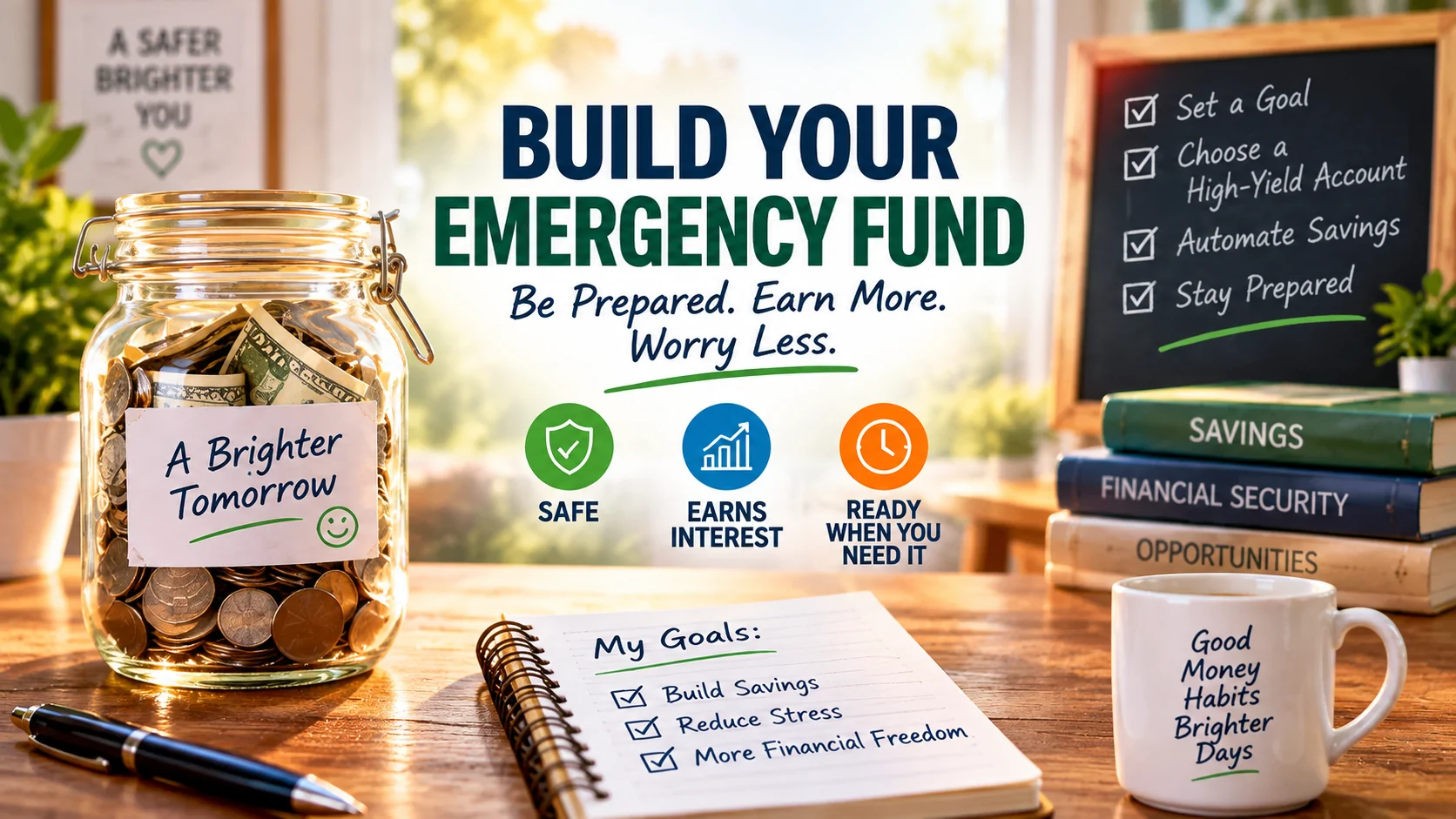
Open a separate federally insured savings account with a competitive APY and reasonable access.
Verify FDIC or NCUA coverage rather than relying on advertising.
Set up an automatic transfer every payday.
Use a portion of windfalls to accelerate the fund.
Keep predictable expenses in separate savings categories when practical.
Use the fund when a genuine emergency happens.
Replenish it afterward and review the target at least once each year.
That is it.
You do not need a complicated spreadsheet.
You do not need to predict the economy.
You do not need to find the highest-paying savings account in America.
You need a target, a safe place for the money, an automatic contribution, and the discipline to leave it alone until you actually need it.
- Frequently Asked Questions
How much should I have in an emergency fund?
There is no universal number.
Three to six months of essential expenses is a useful starting framework, but the right amount depends on income stability, household size, insurance coverage, debt, health, employment prospects, homeownership, and other risks.
Start with a smaller achievable reserve and build from there.
Is $1,000 enough?
It may be an excellent starter fund, particularly if the alternative is having no savings at all.
But $1,000 will not replace several months of lost income for most households.
Think of it as the first milestone rather than necessarily the final destination.
Should I keep my emergency fund in checking?
You can keep a small immediate-access cushion in checking.
For the larger reserve, a separate interest-bearing savings account may make it easier to earn more and avoid accidental spending.
Is a high-yield savings account safe?
A deposit account held directly at an FDIC-insured bank is generally insured within FDIC limits.
At a federally insured credit union, qualifying shares are protected under NCUA insurance limits.
Always verify the institution and understand the account structure.
Can a high-yield savings rate go down?
Yes.
Most savings-account rates are variable.
The APY offered today is not normally guaranteed indefinitely.
Should I move my savings every time another bank offers a better APY?
Probably not for tiny differences.
Compare the actual dollar benefit along with fees, convenience, customer service, insurance, and access.
Should I keep emergency money in a money market fund?
A money market mutual fund can be a relatively conservative investment, but it is not the same as an FDIC-insured money market deposit account.
For your core emergency reserve, understand the additional differences in protection and access before making that choice.
Should I use an emergency fund instead of a credit card?
For a genuine emergency, that is one of the main reasons the fund exists.
Using your own money can prevent an unexpected expense from turning into high-interest revolving debt.
What if I can only save $10 or $20 at a time?
Start there.
The CFPB emphasizes that even small amounts can provide some financial security.
Consistency matters more than waiting until you can save a large amount.
- The Bottom Line
An emergency fund is not supposed to make you rich.
It is supposed to prevent an ordinary financial problem from becoming a financial crisis.
But safety does not require accepting a terrible return.
Your emergency savings can be:
Protected.
Accessible.
Separate from everyday spending.
And earning interest while it waits.
Start small if you need to.
Build one month.
Then another.
Automate it.
Review it.
And do not feel guilty when a genuine emergency eventually forces you to use it.
That is not the emergency fund failing.
That is the emergency fund doing exactly what you built it to do.
The best emergency fund is not the account with the fanciest app or the highest advertised APY.
It is the money that is actually there when you need it.
Official Sources & Further Reading
For information about emergency savings and building a savings habit, consult the Consumer Financial Protection Bureau.
For bank-deposit insurance and verifying whether a bank is federally insured, consult the Federal Deposit Insurance Corporation.
For federally insured credit-union accounts, consult the National Credit Union Administration.
For information about money market mutual funds and other investment products, consult Investor.gov, a resource of the U.S. Securities and Exchange Commission.
For federal tax treatment of savings-account interest, consult the Internal Revenue Service.
Important: This article provides general educational information and is not individualized financial, investment, banking, tax, or legal advice. Account terms, interest rates, deposit-insurance arrangements, and tax laws can change. Verify current terms and protections before opening or funding a financial account.