Less than a year ago, the story was about Federal Reserve rate cuts.
Now the story has changed.
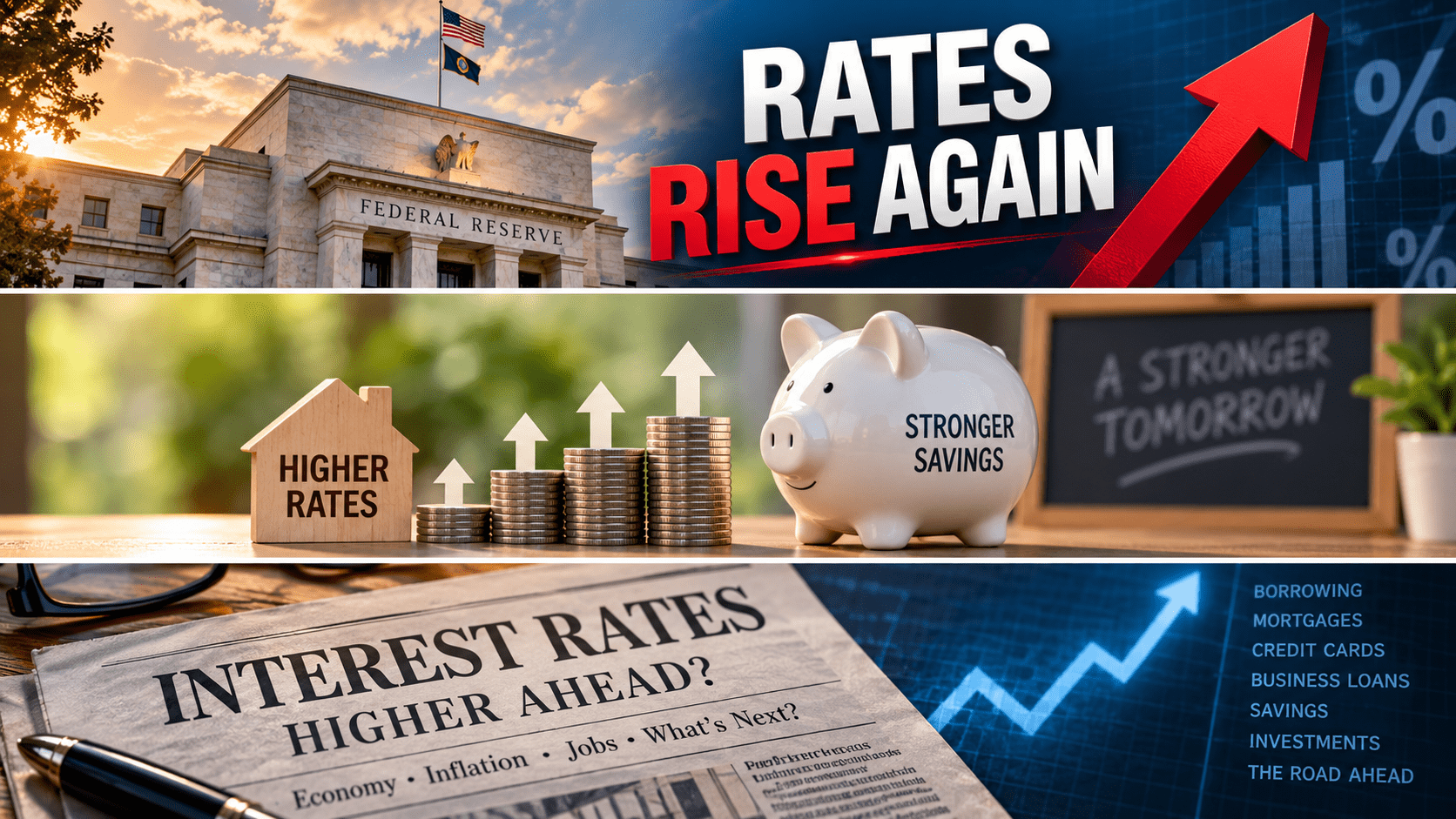
On September 16, 2026, the Federal Reserve raised its target range for the federal funds rate by 0.25 percentage point, bringing it to:
3.75%–4.00%
That may seem like a small move.
But when the Federal Reserve changes interest rates, the effects can eventually reach:
- Credit cards
- Home-equity lines of credit
- Business borrowing
- Auto loans
- Savings accounts
- Money-market funds
- Certificates of deposit
- Bond markets
- Mortgage rates
- Investment valuations
And perhaps most importantly, the September move tells us something about how the Federal Reserve sees the economy right now.
Last fall, the question was:
Why is the Fed cutting rates?
Today, the better question is:
Why is the Fed raising them again?
Let’s break down what changed, how a Fed rate increase works, and what it may mean for households, savers, borrowers, investors, and small businesses.
1. What Did the Federal Reserve Do?
At its September 15–16, 2026 meeting, the Federal Open Market Committee voted to increase its target range for the federal funds rate by:
0.25 percentage point
The new target range is:
3.75% to 4.00%
This was the first increase after a period in which the Federal Reserve had been moving rates lower.
That change in direction is important.
It does not necessarily mean the Federal Reserve has begun a long new cycle of rate increases.
It does mean policymakers concluded that monetary policy needed to become somewhat more restrictive again.
The stated reason was straightforward:
Inflation remains elevated.
The Federal Reserve’s long-run inflation objective remains 2%.
2. Why Did the Fed Reverse Course?
Monetary policy changes because economic conditions change.
The Federal Reserve does not have to remain permanently committed to either cutting rates or raising them.
Its decisions depend on incoming data and its dual mandate:
- Maximum employment
- Price stability
During 2025, falling inflation pressures created room for the Fed to reduce rates.
By September 2026, the picture had changed.
Inflation was still running above the Fed’s target, while economic activity and employment remained relatively resilient.
That combination gave the Fed more room to address inflation without responding to an obvious collapse in employment.
3. Inflation Is Still the Main Problem
Inflation is the central reason for the September rate increase.
The Consumer Price Index rose 3.4% over the 12 months ending August 2026.
During August alone, CPI increased 0.4% on a seasonally adjusted basis.
Core CPI—which excludes food and energy—was lower, rising 2.4% over the year.
Energy was a major contributor to the headline figure, with the energy index up sharply over the prior year.
The Federal Reserve usually focuses heavily on another inflation measure:
The Personal Consumption Expenditures Price Index, or PCE.
For July 2026:
- Headline PCE inflation was 3.7% year over year
- Core PCE inflation was 3.3%
Both remained above the Fed’s 2% objective.
So while inflation is far below the extreme levels experienced earlier in the decade, it is not yet back where policymakers want it.
4. But the Economy Is Not Falling Apart
If inflation were high while unemployment was surging and the economy were contracting sharply, the Fed would face a much more difficult decision.
That is not the current picture.
In August 2026:
- U.S. payroll employment increased by 162,000
- The unemployment rate remained 4.1%
The Federal Reserve described economic activity as expanding at a solid pace.
It also pointed to:
- Resilient domestic spending
- Strong productivity growth
- Robust capital investment
- Job growth keeping pace with the workforce
That matters because the Fed is constantly balancing inflation against employment.
A reasonably resilient labor market gives policymakers more freedom to keep monetary policy tight—or tighten it further—without immediately prioritizing unemployment concerns.
5. What Is the Federal Funds Rate, Anyway?
The federal funds rate is not your mortgage rate.
It is not your credit-card rate.
And it is not the rate your bank pays on savings.
The federal funds rate is the interest rate banks charge one another for very short-term overnight lending.
The Federal Reserve sets a target range for that rate and uses monetary-policy tools to keep market rates near that range.
So why does everyone care?
Because the federal funds rate sits near the foundation of the U.S. interest-rate system.
When it changes, other borrowing and savings rates often respond.
But they do not all move:
- Immediately
- By exactly the same amount
- Or even in the same direction
That distinction is important.
6. What Higher Fed Rates Can Mean for Credit Cards
Credit cards are among the financial products most directly affected by changes in short-term interest rates.
Many variable credit-card rates are tied indirectly to the prime rate, which tends to move closely with Federal Reserve policy.
When Fed rates rise:
Variable credit-card borrowing can become more expensive.
A quarter-point increase may not sound dramatic on one month’s statement.
But for someone carrying a large revolving balance, repeated rate increases can add meaningful interest expense over time.
Example
Suppose you carry a:
$10,000 balance
A rate increase of 0.25 percentage point would add roughly:
$25 per year
in simple interest if the balance remained unchanged.
That sounds small.
But credit-card APRs are already high, and Fed moves can accumulate.
The bigger lesson is not that one quarter-point hike will ruin a household budget.
It is that variable-rate debt becomes increasingly expensive when monetary policy tightens.
7. What About HELOCs and Variable-Rate Loans?
Home-equity lines of credit, or HELOCs, are another area where Fed moves can show up relatively quickly.
Many HELOCs use a variable interest rate tied to the prime rate.
So when short-term interest rates rise:
The required payment on a HELOC may increase.
The same can be true for:
- Some personal loans
- Business lines of credit
- Variable-rate commercial loans
- Certain adjustable-rate debt
Borrowers should know whether their rate is:
- Fixed
- Variable
- Tied to prime
- Tied to another benchmark
That one detail can make a large difference in how quickly Fed policy reaches your monthly cash flow.
8. Does a Fed Hike Mean Mortgage Rates Automatically Go Up?
No.
This is one of the most important misconceptions about Federal Reserve policy.
The Fed does not directly set 30-year mortgage rates.
Mortgage rates are influenced much more directly by:
- Longer-term Treasury yields
- Inflation expectations
- Economic growth expectations
- Mortgage-backed securities markets
- Investor demand
- Credit conditions
The Fed matters because monetary policy affects expectations throughout financial markets.
But a 0.25% Fed hike does not mean a 30-year mortgage automatically rises by 0.25%.
Mortgage rates could:
- Rise
- Fall
- Or remain relatively unchanged
depending on what bond markets had already expected and what investors believe will happen next.
For Homebuyers
The lesson is simple:
Do not assume you can predict mortgage rates from one Fed meeting.
Focus instead on:
- The monthly payment you can actually afford
- Your down payment
- Closing costs
- Property taxes
- Insurance
- Your credit profile
- The rate available when you are actually ready to buy
9. What Does This Mean for Auto Loans?
Auto-loan rates are influenced by market interest rates, credit conditions, vehicle incentives, loan terms, and borrower credit quality.
A Fed hike can put upward pressure on borrowing costs.
But the effect will differ substantially from borrower to borrower.
A manufacturer offering promotional financing may behave differently from a bank or credit union making a conventional auto loan.
So again:
The Fed influences borrowing conditions—it does not dictate the exact rate on every loan.
10. There Is a Winner in Higher Rates: Savers
Higher interest rates are not bad for everyone.
For savers, higher rates can mean better returns on:
- High-yield savings accounts
- Money-market accounts
- Money-market funds
- Certificates of deposit
- Treasury bills
- Other short-term fixed-income investments
This is the flip side of monetary tightening.
Borrowers generally dislike higher rates.
Savers may welcome them.
But Don’t Assume Your Bank Will Automatically Pay More
Banks do not have to raise deposit rates every time the Fed raises rates.
Some banks compete aggressively for deposits.
Others do not.
That means consumers should compare yields instead of assuming their existing savings account is competitive.
11. What Happens to Bonds When Rates Rise?
Bond prices and interest rates generally move in opposite directions.
If newly issued bonds begin offering higher yields, existing bonds paying lower rates may become less attractive.
Their market prices can fall.
This effect is particularly important for longer-duration bonds, which tend to be more sensitive to changing interest rates.
But bond markets also anticipate Fed decisions.
If investors were already expecting a rate increase, much of the adjustment may have occurred before the Fed actually made the announcement.
That is another reason why financial markets sometimes behave in ways that appear strange:
The market is often reacting to what changed relative to expectations—not simply to what happened.
12. What Could Higher Rates Mean for Stocks?
There is no reliable rule saying:
“Fed raises rates, stocks go down.”
Higher rates can create pressure on stock valuations because future corporate earnings may be discounted at higher rates and investors may have more attractive alternatives in bonds or cash.
Higher borrowing costs can also pressure corporate profits.
But stock prices depend on many other factors, including:
- Earnings
- Economic growth
- Productivity
- Technology
- Consumer spending
- Taxes
- Regulation
- Global developments
- Investor expectations
A strong economy can sometimes support corporate earnings even while interest rates remain elevated.
So Fed policy is important—but it is never the only thing driving markets.
13. Small Businesses Should Pay Close Attention
For small-business owners, interest rates can reach far beyond the monthly payment on one loan.
Higher rates can affect:
- Lines of credit
- Working-capital financing
- Equipment purchases
- Commercial real estate
- Inventory financing
- Expansion plans
- Customer demand
- Cash-management decisions
A business borrowing $50,000 for inventory will feel higher rates differently from a business holding $500,000 in short-term cash.
That makes interest-rate changes a cash-flow issue, not simply an economics headline.
14. A Simple Business Borrowing Example
Suppose a business has:
$100,000 outstanding on a variable-rate line of credit
If the interest rate rises by 0.25 percentage point, the additional annual interest expense is roughly:
$250
assuming the balance stays at $100,000 for the entire year.
One quarter-point increase alone may not be devastating.
But imagine rates rising a total of:
2 percentage points
That same balance would cost approximately:
$2,000 more per year
in interest.
Now multiply that effect across:
- Equipment loans
- Credit cards
- Lines of credit
- Commercial debt
and rates can become a meaningful operating expense.
15. Five Things Small-Business Owners Should Review Now
A change in Fed policy is a good reminder to review your financing and cash management.
1. Know Which Debt Is Variable
Make a list of:
- Loans
- Credit cards
- Lines of credit
- Commercial mortgages
- Equipment financing
Then identify which rates can change.
2. Review Your Line of Credit
A revolving line of credit can be extremely useful.
But if the rate is variable, make sure your cash-flow projections reflect current borrowing costs.
3. Revisit Planned Purchases
A piece of equipment can still be a good investment even when financing costs rise.
But the hurdle is higher.
Look at the total expected return—not just the monthly payment.
4. Check What Your Cash Is Earning
A business with substantial operating cash should periodically compare available yields.
Idle cash earning almost nothing becomes more noticeable when short-term market rates are near 4%.
5. Stress-Test Cash Flow
Ask:
What happens if borrowing costs remain elevated for another year?
A useful forecast should not depend entirely on rapid future rate cuts.
16. The Fed’s September Projections Tell an Interesting Story
Along with its September decision, Federal Reserve officials released updated economic projections.
The median projections included:
| Federal Reserve Median Projection | 2026 | 2027 | 2028 | 2029 |
|---|---|---|---|---|
| Real GDP growth | 2.3% | 2.4% | 2.2% | 2.1% |
| Unemployment rate | 4.1% | 4.1% | 4.1% | 4.1% |
| PCE inflation | 3.7% | 2.3% | 2.1% | 2.0% |
| Core PCE inflation | 3.4% | 2.5% | 2.2% | 2.0% |
| Federal funds rate | 4.1% | 4.1% | 3.9% | 3.6% |
Those numbers are revealing.
Fed participants, in the median, currently envision:
- Continued economic growth
- A relatively stable unemployment rate
- Inflation gradually returning toward 2%
- Interest rates remaining relatively elevated for some time
But there is an important warning:
These are projections, not promises.
They are individual policymakers’ assessments based on information available at the September meeting.
They can—and do—change.
17. The Fed’s Own Projections Changed Quickly
One of the best lessons from 2025 and 2026 is that interest-rate expectations should never be treated as guarantees.
In June 2026, the median Fed participant projected a lower year-end federal funds rate than the one shown in September.
By September, the median projected year-end 2026 rate had moved to:
4.1%
That tells us something important about monetary policy:
The Fed responds to the economy it gets—not the economy it expected six months earlier.
Forecasts are useful.
But they are not contracts.
18. What Happens Next?
The Federal Reserve has not promised another rate increase.
Nor has it promised that the next move will be a cut.
Future decisions will depend on incoming information.
The major things to watch include:
Inflation
Does PCE inflation continue moving toward 2%, or remain stubbornly above target?
Employment
Does unemployment remain near current levels, or does the labor market weaken materially?
Consumer Spending
Are households continuing to spend, or is demand slowing?
Economic Growth
Does the economy keep expanding at a healthy pace?
Financial Conditions
What happens to:
- Treasury yields
- Credit spreads
- Bank lending
- Mortgage rates
- Financial markets
The Fed will weigh all of these factors together.
19. The Next Fed Meetings
After the September meeting, the remaining scheduled FOMC meetings for 2026 are:
- October 27–28
- December 8–9
But those dates should not be treated as guaranteed rate-change dates.
The Fed can:
- Raise rates
- Cut rates
- Leave rates unchanged
The decision depends on the economic data available at the time.
20. What Should Consumers Do?
Fed decisions can tempt people into trying to predict the next move.
That is usually less useful than controlling the things you actually can control.
If You Carry Credit-Card Debt
High-interest variable debt deserves attention regardless of whether the Fed raises or lowers rates at the next meeting.
If You Are Buying a Home
Focus on affordability and your total housing payment rather than trying to perfectly time the Fed.
If You Have Cash Savings
Check whether your money is earning a competitive rate.
If You Have Variable-Rate Debt
Know how often your rate resets and what benchmark it follows.
If You Are Planning a Major Purchase
Calculate the total financing cost—not merely the sticker price.
21. What Should Investors Do?
Interest rates matter.
But one Fed meeting is rarely a good reason to abandon a well-considered investment plan.
Different investments respond differently to changes in:
- Inflation
- Interest rates
- Growth
- Corporate profits
- Market expectations
Rather than trying to trade every Fed announcement, investors should understand how much interest-rate risk, stock-market risk, and cash exposure they already have.
The appropriate mix depends on the investor—not simply on the latest FOMC decision.
22. Rate Hikes Do Not Reduce Prices Back to Where They Were
This distinction is extremely important.
When the Federal Reserve talks about reducing inflation, it usually means slowing the rate at which prices are increasing.
It does not necessarily mean returning the overall price level to where it was several years ago.
For example:
If something rises from:
$100 to $110
that is a 10% increase.
If inflation then falls sharply, the item does not automatically return to $100.
It may simply rise more slowly from the new $110 level.
That is why people can hear that “inflation is coming down” while still feeling that everyday life is expensive.
Both statements can be true.
23. Why the Fed Doesn’t Just Crush Inflation Immediately
If higher rates can reduce inflation, why not raise them dramatically and solve the problem quickly?
Because monetary policy has costs.
Very high rates can:
- Reduce business investment
- Slow homebuilding
- Reduce consumer borrowing
- Weaken employment
- Increase loan defaults
- Pressure financial markets
- Potentially contribute to a recession
The Federal Reserve is therefore trying to balance competing objectives.
It wants inflation back near 2%.
But it also wants to avoid unnecessarily damaging employment and economic activity.
That balancing act is the essence of monetary policy.
24. From Rate Cuts to Rate Hikes: What Changed Since 2025?
In October 2025, CPA at Large looked at the Federal Reserve’s rate-cutting cycle and explained why monetary policy was becoming less restrictive.
That article reflected the conditions at that time.
The important lesson from the September 2026 rate increase is that monetary policy is not a one-way road.
The basic sequence looks something like this:
2024–2025
Inflation pressures eased enough for the Federal Reserve to begin lowering interest rates.
2026
Inflation remained above target and renewed price pressures emerged, while economic growth and employment remained resilient.
September 2026
The Fed increased the federal funds target range to 3.75%–4.00%.
That does not mean the earlier rate cuts were necessarily a mistake.
It means economic conditions evolved.
And monetary policy evolved with them.
Related reading: The Fed’s Rate Cuts: What’s Happening, How It Works, and What It Means Next
25. Frequently Asked Questions
Did the Federal Reserve raise rates in September 2026?
Yes.
The Fed increased the federal funds target range by 0.25 percentage point to 3.75%–4.00%.
Why did the Fed raise rates?
The Fed said inflation remained elevated and that the rate increase would support a more timely return toward its 2% inflation goal.
Does this mean my mortgage rate just went up 0.25%?
No.
Mortgage rates are influenced primarily by longer-term bond markets, inflation expectations, and other factors.
Will my credit-card rate increase?
Possibly.
Many variable credit-card rates are connected to the prime rate and can respond relatively quickly to changes in short-term rates.
Are higher rates good for savings accounts?
They can be.
Higher short-term rates often allow banks, money-market funds, CDs, and Treasury bills to offer higher yields, although individual institutions determine what they pay.
Will the Fed raise rates again?
That is not known.
Future decisions will depend on inflation, employment, economic activity, and other incoming data.
Is inflation still high?
Inflation remains above the Federal Reserve’s 2% goal.
CPI was 3.4% higher than a year earlier in August 2026, while the July PCE price index was 3.7% higher than a year earlier.
Is the economy in a recession?
Current data do not show the broad conditions typically associated with a declared recession. Employment continued to expand in August, unemployment was 4.1%, and the Federal Reserve described economic activity as expanding at a solid pace.
That does not guarantee future conditions.
26. The Bottom Line
The September 2026 Fed rate increase is important.
But it is not a reason to panic.
And it is not a reason to assume we know exactly what interest rates will do next.
The more useful takeaway is this:
Inflation is still above target.
The economy and labor market remain relatively resilient.
The Fed decided monetary policy needed to become somewhat tighter again.
For borrowers, that can mean continued pressure from higher financing costs.
For savers, it can mean continued opportunities to earn meaningful yields on cash.
For small businesses, it makes debt management, working-capital planning, and cash-flow forecasting even more important.
And for everyone, it is a reminder that interest rates affect far more than Wall Street.
They affect:
What you earn on savings.
What you pay to borrow.
What a house costs each month.
What a business pays to expand.
And how money moves throughout the economy.
Last year, the Fed was cutting rates.
This year, it just raised them.
What happens next will depend on what inflation, employment, and the broader economy do from here.
Rather than trying to guess every Fed move, understand how interest rates affect your own financial picture.
That knowledge is useful whether rates go up, down, or nowhere at all.
Official Sources & Further Reading
For current monetary-policy decisions, meeting calendars, and economic projections, consult the Board of Governors of the Federal Reserve System.
For inflation data, consult the U.S. Bureau of Labor Statistics and the U.S. Bureau of Economic Analysis.
For current labor-market information, consult the Bureau of Labor Statistics Employment Situation reports.
Important: This article is intended for general educational purposes and does not constitute individualized financial, investment, lending, or economic advice. Interest rates, financial markets, loan terms, and economic conditions can change rapidly. Decisions should be based on your own financial circumstances and, when appropriate, advice from qualified professionals.